The outside records, in date order, with your specialty’s lines marked.
A new patient brings 200 faxed pages from three health systems. Your front desk drops the PDF into this page. A few minutes later the doctor has one timeline, with the repeats folded and every line tied to the page it came from.
Open the sample packetStart a trial
Three packets are free and you do not need a card. It runs in the browser you already have, and the file stays on your computer.
The sample is a 29-page heart and kidney packet. There is also a Psychiatry sample and a Crohn’s disease sample, 12 pages each.
One packet from fax to brief
What comes through the fax
| As it arrived | After Priorfolio read it |
|---|---|
| 29 pages, in the order three fax machines sent them | 22 documents from 2017 to 2026, oldest to newest |
| The 2022 echo, an ECG and the medication list were each sent twice | Each appears once, with a note pointing to the second copy |
| Page 12 is a lab report for a different patient | Flagged in red, and its numbers are left out of every table |
| Four pages are scans with no text in them | Read on your computer, each with a confidence figure |
| The 2026 cardiology note repeats 61% of the 2024 note | The repeated lines are faded so the new ones are easy to find |
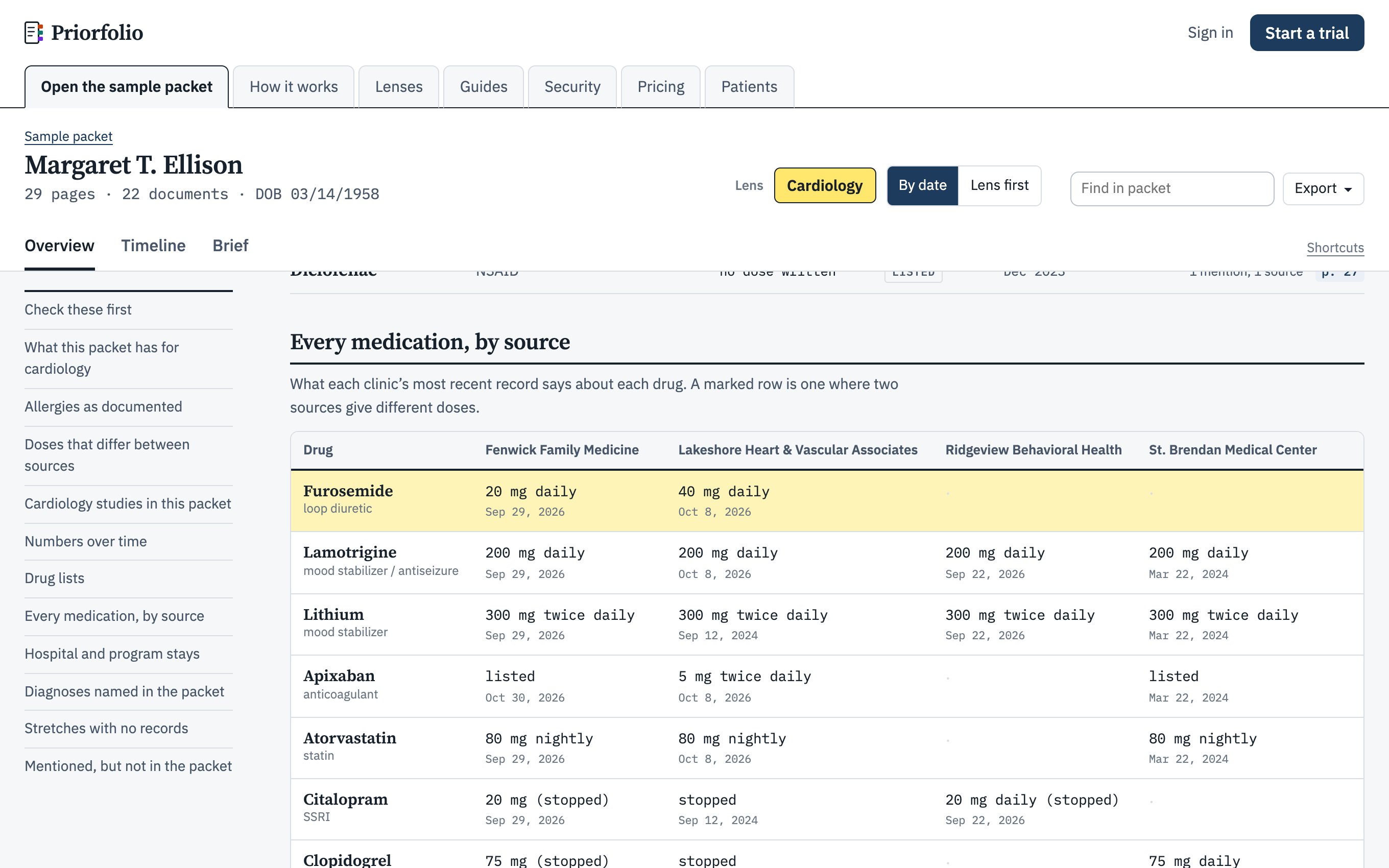
| The cardiologist wrote furosemide 40 mg. The family doctor’s list says 20 mg. | Both lines are shown together, each with its page |
| Notes mention a stress test, a repeat EGD, a kidney ultrasound and a sleep study that were never sent | They are listed, with a request letter for each office ready to print |
Every page is kept, and your part of it is marked
Most tools for outside records write you a paragraph. To write it they leave things out, and you have no way to know which things. A cardiologist and a psychiatrist reading the same chart need different halves of it.
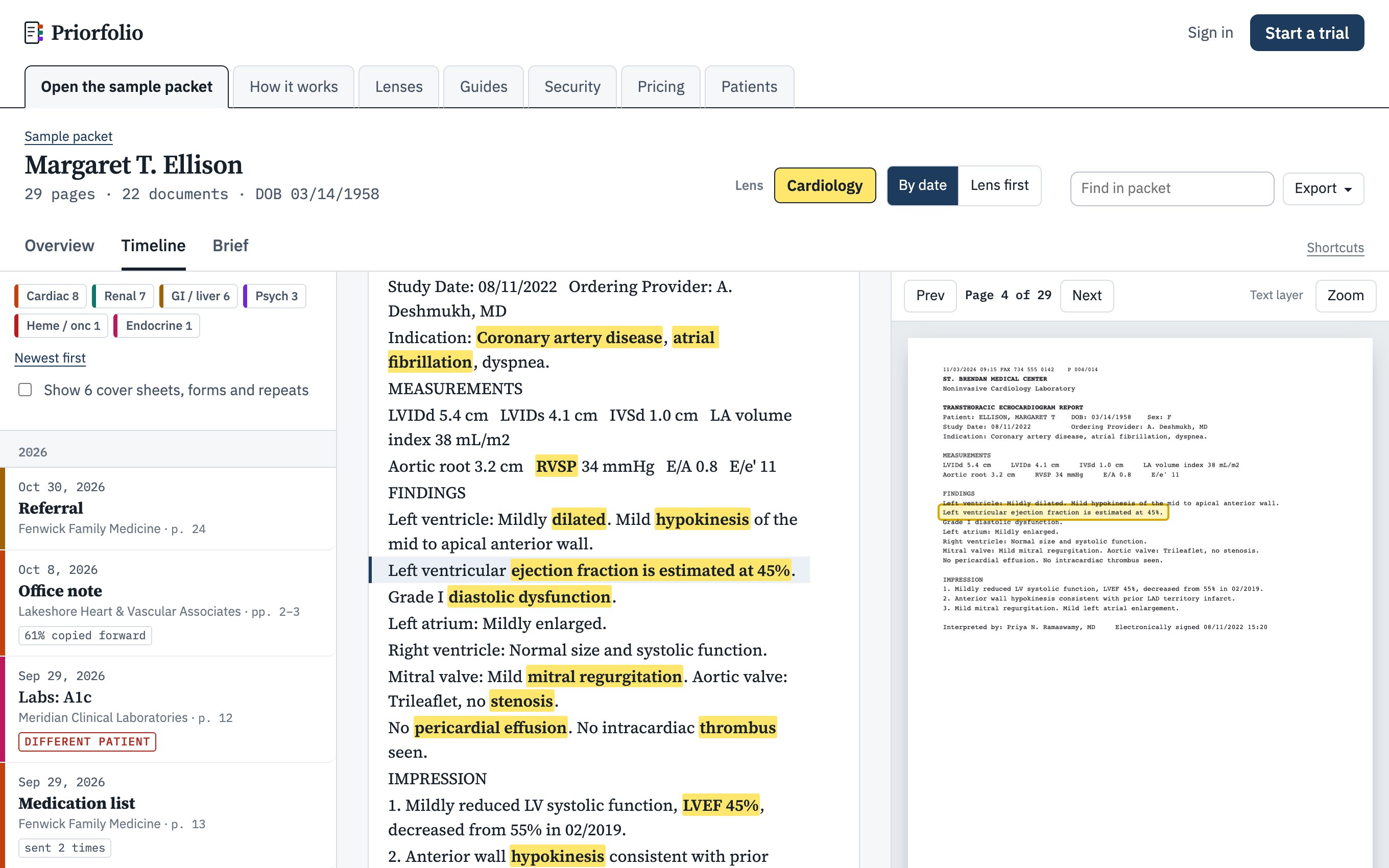
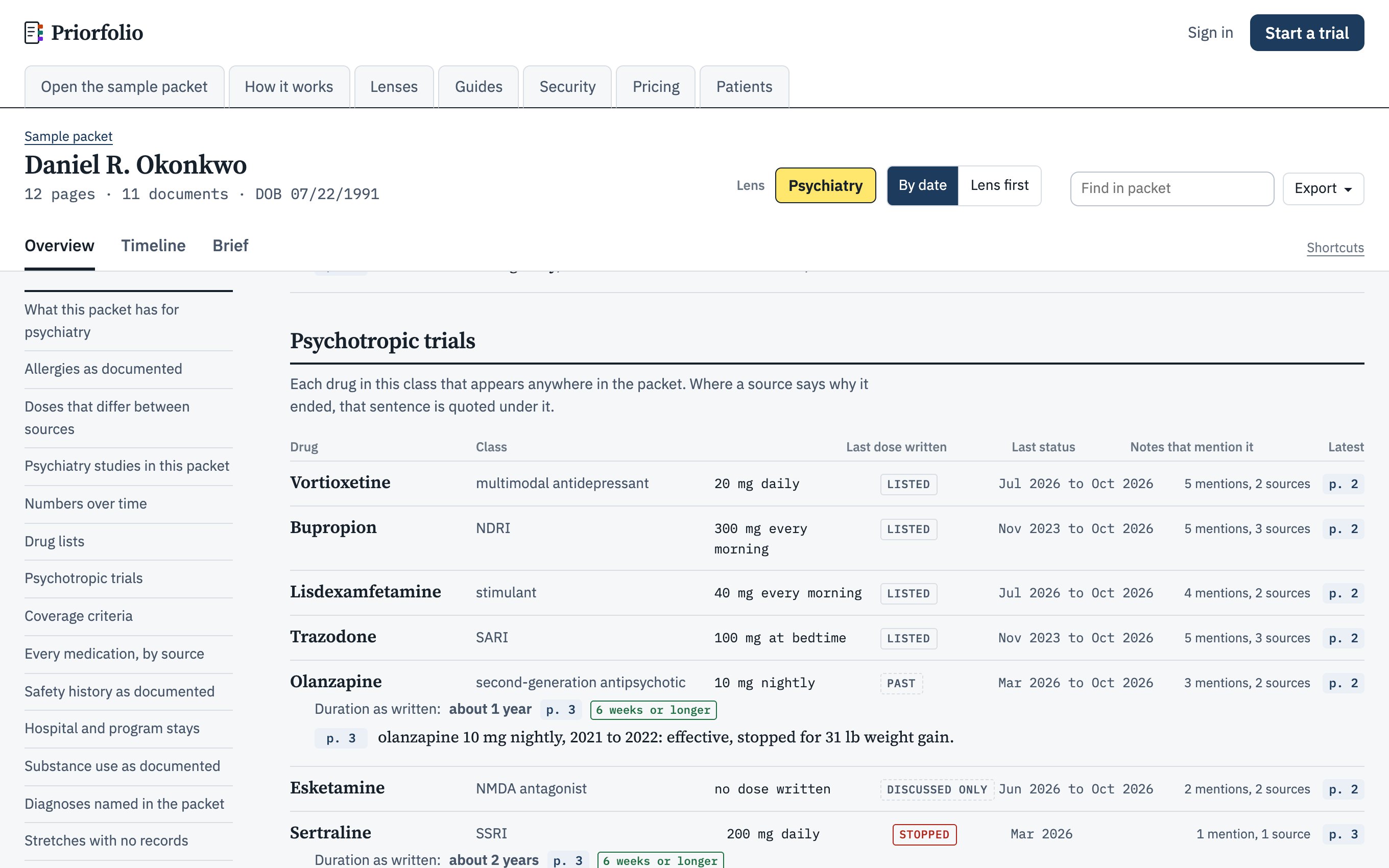
Priorfolio leaves the record whole. It works out what each document is and when it happened, and puts them in order. Then it applies a lens. A lens marks the drugs, numbers, studies and phrases your specialty reads for, and moves the documents you would ask for first to the top. Change the lens and the marks change. Turn it off and you have the plain record in date order.
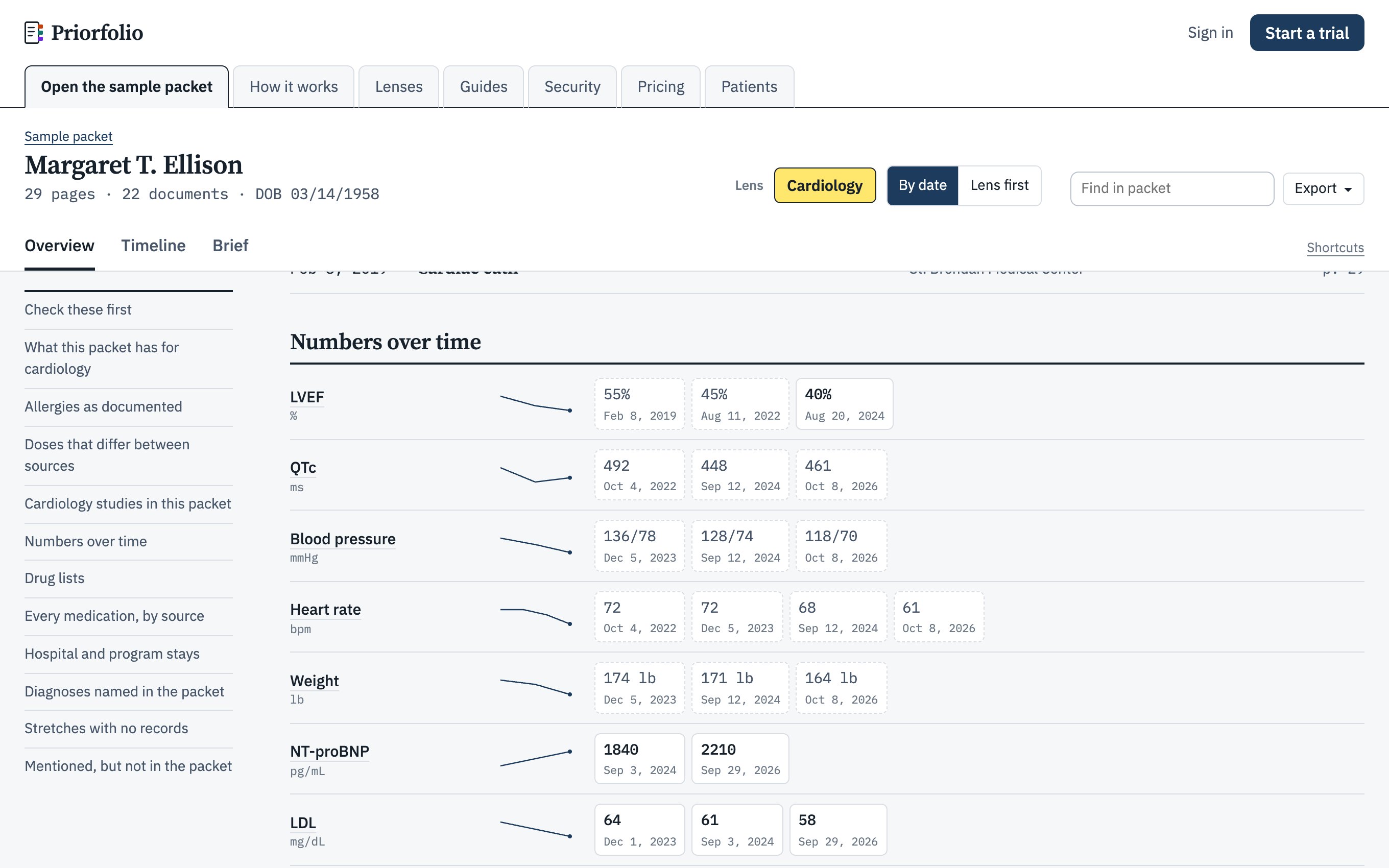
No language model writes any of the text. A value in a table is the value as it was printed, and pressing it opens the page with that line boxed.
From fax tray to exam room
At the front desk
about two minutes, whenever the fax lands
- Drop in the packet. One PDF, several, or phone photos if that is what you were handed. You can also point Priorfolio at the folder your fax service saves to, and new faxes line up by themselves.
- Leave it reading. Pages with text are read at once. Scans take a few seconds each and keep going while you work in another tab.
- Look at the flags. A page for the wrong patient, or a scan too faint to read, shows up before the doctor opens anything.
- Send the request. When a note mentions a study nobody sent, print the letter that asks for it. When the report arrives, add it to the same packet.
In the doctor’s hands
a few minutes, before the patient is roomed
- Start on the overview. It shows numbers over time, every medication by source, why each drug was stopped, and the prior studies with their impressions.
- Read the timeline. The text is on the left and the scanned page is on the right, with the line you pressed boxed on it.
- Mark what matters. Any line can go onto a one-page brief. The brief prints with a page number on every row, or pastes into your note as text.
- File the clean copy. Download the packet sorted by date, with the repeats and cover sheets taken out, and attach that to the chart.
A reading list for nine specialties and eight subspecialties
A lens is a plain list of terms, drug classes, lab rows and report types, and each one is published in full. Your practice can copy one and add its own words.
Things a tired reader misses on page 140
A page from someone else’s chart
The name and date of birth on every document are compared with the rest of the packet. A mismatch gets a red stamp, and its numbers are held back.
The same report sent three times
Two offices often forward the same echo. Repeats are matched even when the fax header and page count differ, and folded under the first copy.
A note that is mostly last year’s note
Lines copied forward from an earlier note are faded. A lab value quoted in copied text is not counted as a new result.
Two clinics, two doses
When the most recent records from two sources list the same drug at different doses, both lines are set side by side.
Why a drug was stopped
When a sentence says a medication was discontinued, failed or not tolerated, that sentence is quoted under the drug with its page.
Two years with nothing in them
A long stretch with no dated records is pointed out, so you can ask who the patient was seeing then.
Four things go back into the chart
The same pages in date order, with repeats, cover sheets and the wrong-patient page removed. An index at the front maps each new page number to the original.
The lines the reader marked, the numbers over time and the reports on file. Every row has a page number.
A records request for each office that left something out. A prior-therapy letter listing what was tried, at what dose and why it ended. A medication check sheet for the patient to mark up.
The document list, and every value found with its page, for anyone who wants to check the work.
The records stay on your computer
The reading, sorting and marking all happen inside the browser tab. The PDF is stored by that browser and is never sent to us. Our servers know that your practice read a packet and how many pages it had. They do not know whose it was or what it said.
This is also why you have no integration to approve and no interface to build. A practice that can open a web page can use Priorfolio today.
The Security page has the detail.
$89 a provider each month, or $6 a packet
A provider seat covers one clinician and any number of packets. A practice that sees only a few new patients with outside records each month can buy packet credits and pay for what it reads. The first three packets are free on either plan.